 01
01Find your number
Film one ordinary departure and time the first sign of worry. That number is your starting point — for every dog it’s different.
A calm, step-by-step home plan that starts with one number — how long your dog can really be alone — and tells you exactly what to do after every practice session.
You pick up your keys and your dog’s whole body changes. You’ve tried the chews, the calming music, leaving the radio on, coming back after “just ten minutes” — and come home to a scratched door, a hoarse dog, or a neighbor’s note.
Most advice stops at start small. It never says how small. For one dog that means twenty minutes; for another it means twenty seconds. In a small study that filmed five dogs directly, problem behavior began after just 27 seconds on average.Feuerbacher & Muir 2020
Guess too long, and every practice session teaches your dog that being alone is frightening. That’s why so many home attempts stall — not because owners don’t care, but because nobody gave them the number.
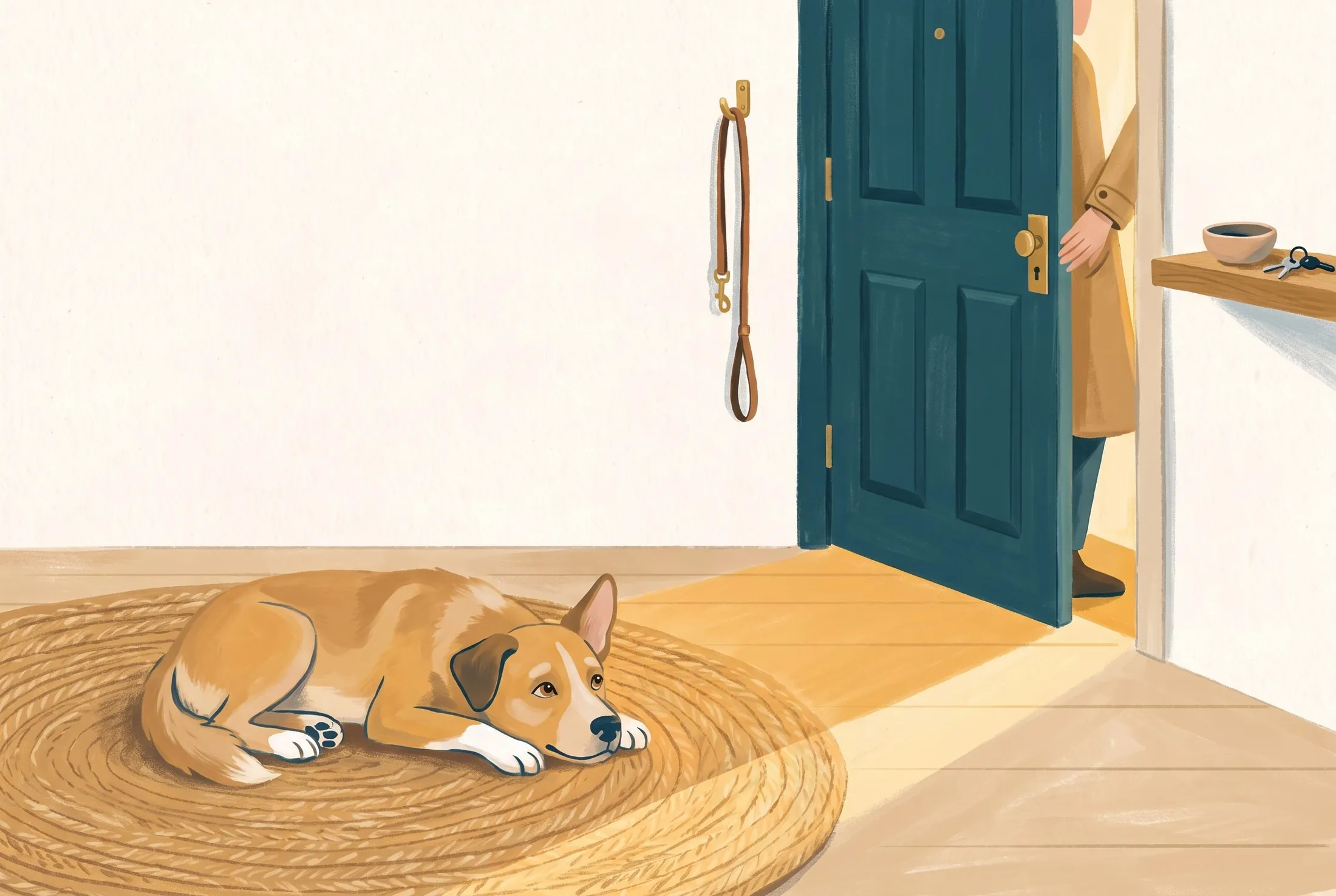
Welfare organizations give one simple rule: keep practice absences shorter than the time it takes your dog to become upset. The threshold test finds that time.
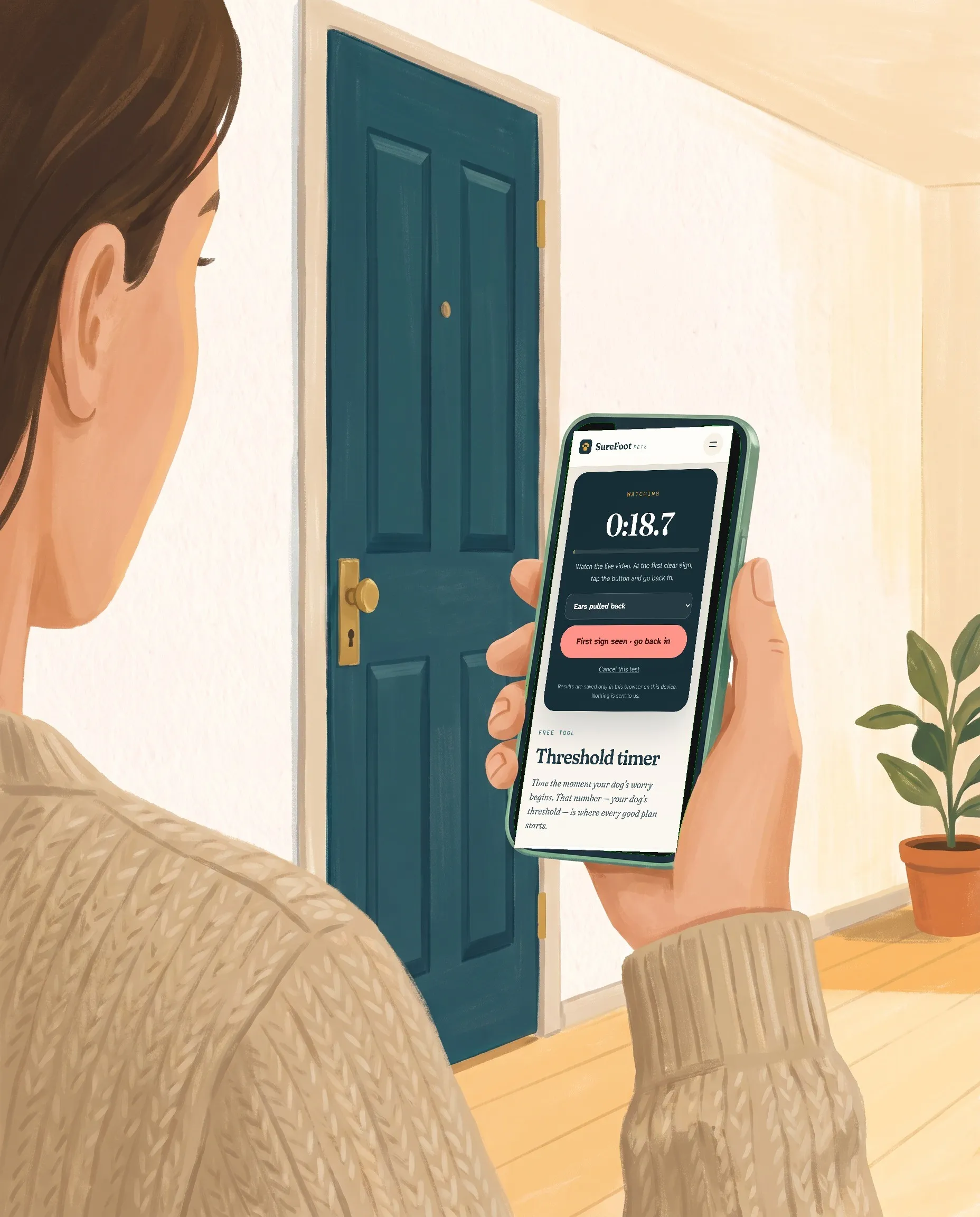
Start the free threshold timer as the door closes, watch your camera, and tap at the first sign of worry. It saves each result, tells you what your number means, and suggests a safe first target.
Works in your browser. Nothing to install, nothing sent to us.
01Film one ordinary departure and time the first sign of worry. That number is your starting point — for every dog it’s different.
 02
02Short, calm absences below the number, a few a day. Tiny steps up — just seconds at first — only when your dog is relaxed.
 03
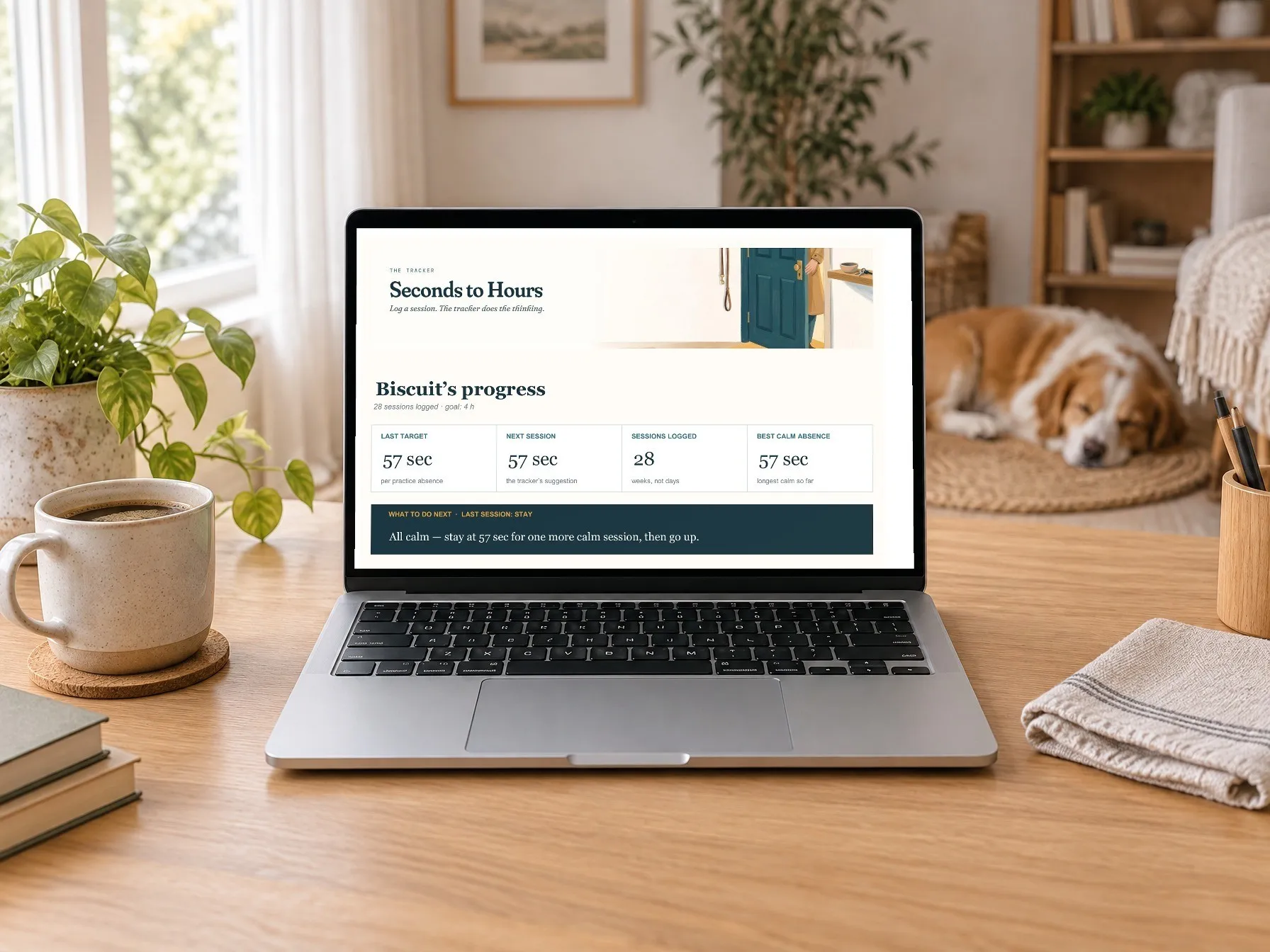
03Log each session in about a minute. It tells you to go up, stay or step back — and raises the stop flag if things go the wrong way.
Every page below is the real product. Tap any page to see it full size.
82 illustrated pages · 9 chapters · 111 sources
19 fillable pages · type on a tablet or print · 4 filled-in examples
Excel · tells you what to do after every session
The whole plan on one page
The question every owner gets stuck on. Add how each practice absence went and see the answer the Tracker gives — the same rules, right here.
Add the result of each rep to see what to do next.
Rules of thumb from the Seconds to Hours guide, built on ASPCA and board-certified behaviorist guidance. Not a diagnosis.
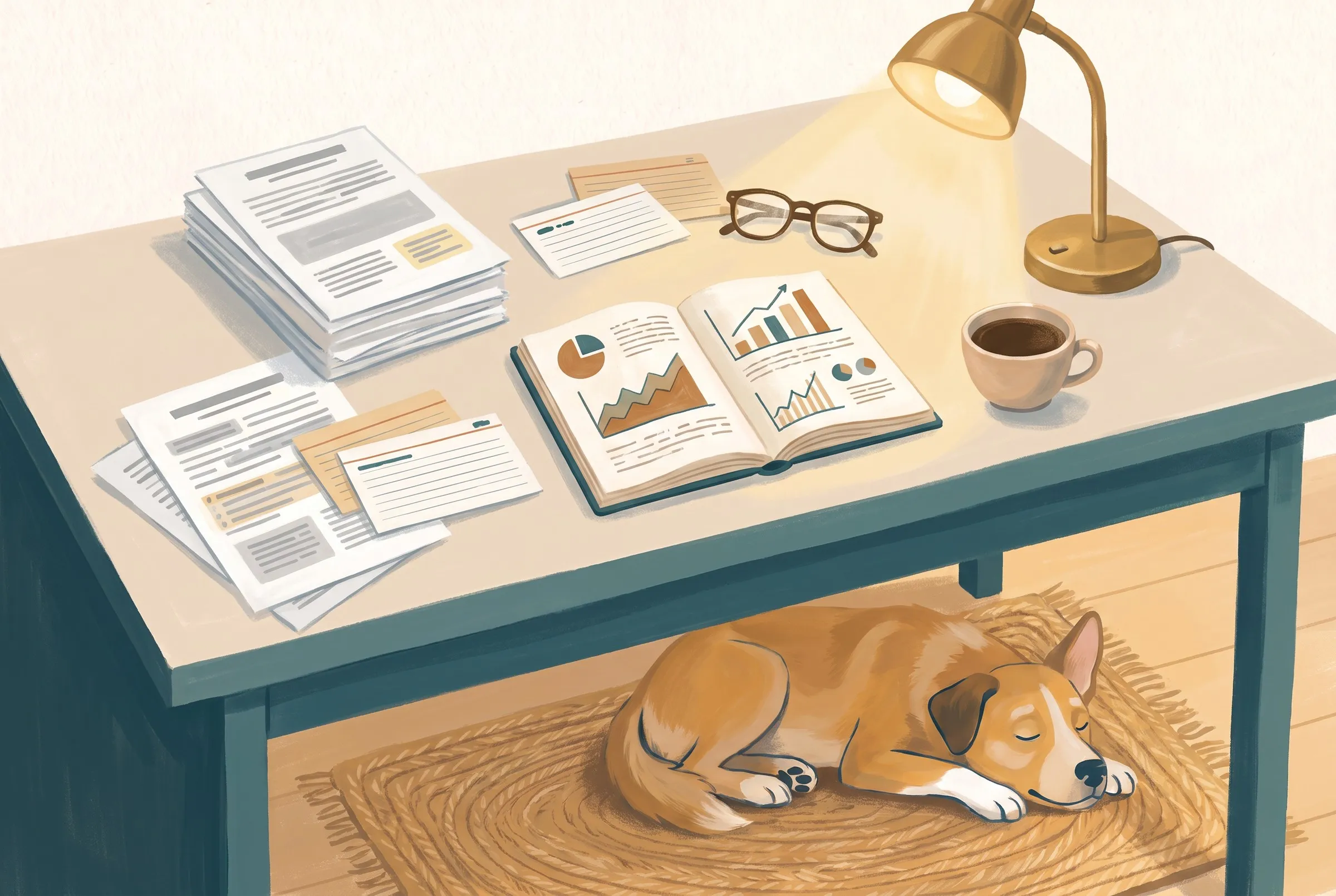
We are not vets, so we don’t ask you to take our word for anything. Every section of the Guide tells you how strong the ground is under your feet.
A finding from peer-reviewed studies, numbered to the reference list.
Guidance from veterinary bodies, welfare organizations and board-certified behaviorists.
A practical step we chose where no study sets a number — and we say so.
People who had never lived with a dog recognized a fearful dog only about 30% of the time. The Guide shows you the signs, in order of how clear they are.
Sources: Wan et al. 2012, PLoS ONE · Gähwiler et al. 2020, Scientific Reports · Silbermann & Gansloßer 2023, Animals.
These dogs deserve an expert from day one. Here’s who to call.
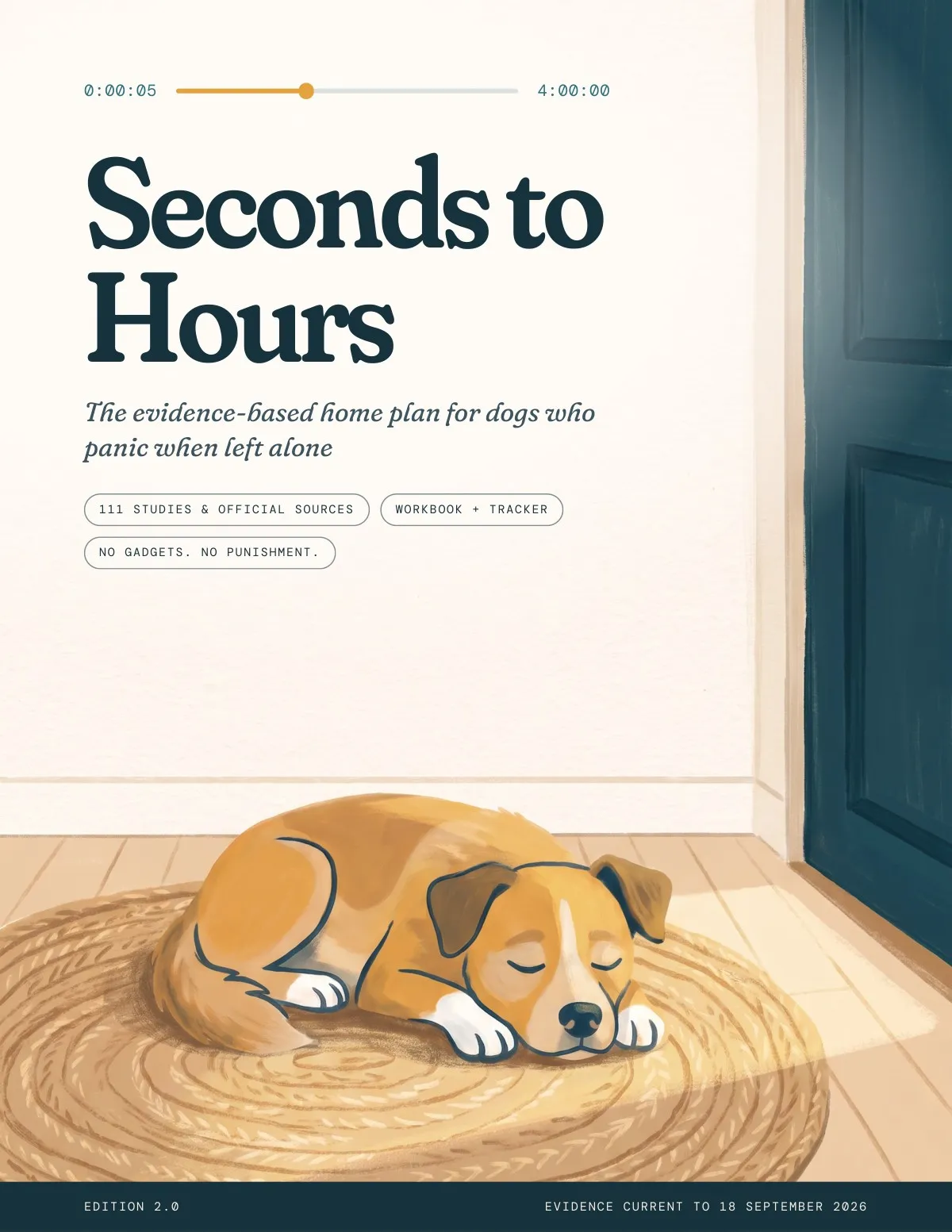
82 illustrated pages, 9 chapters: the threshold test, the plan from seconds to hours, protecting progress, helpers that work (and don’t), medication and who to call, plateaus and setbacks.
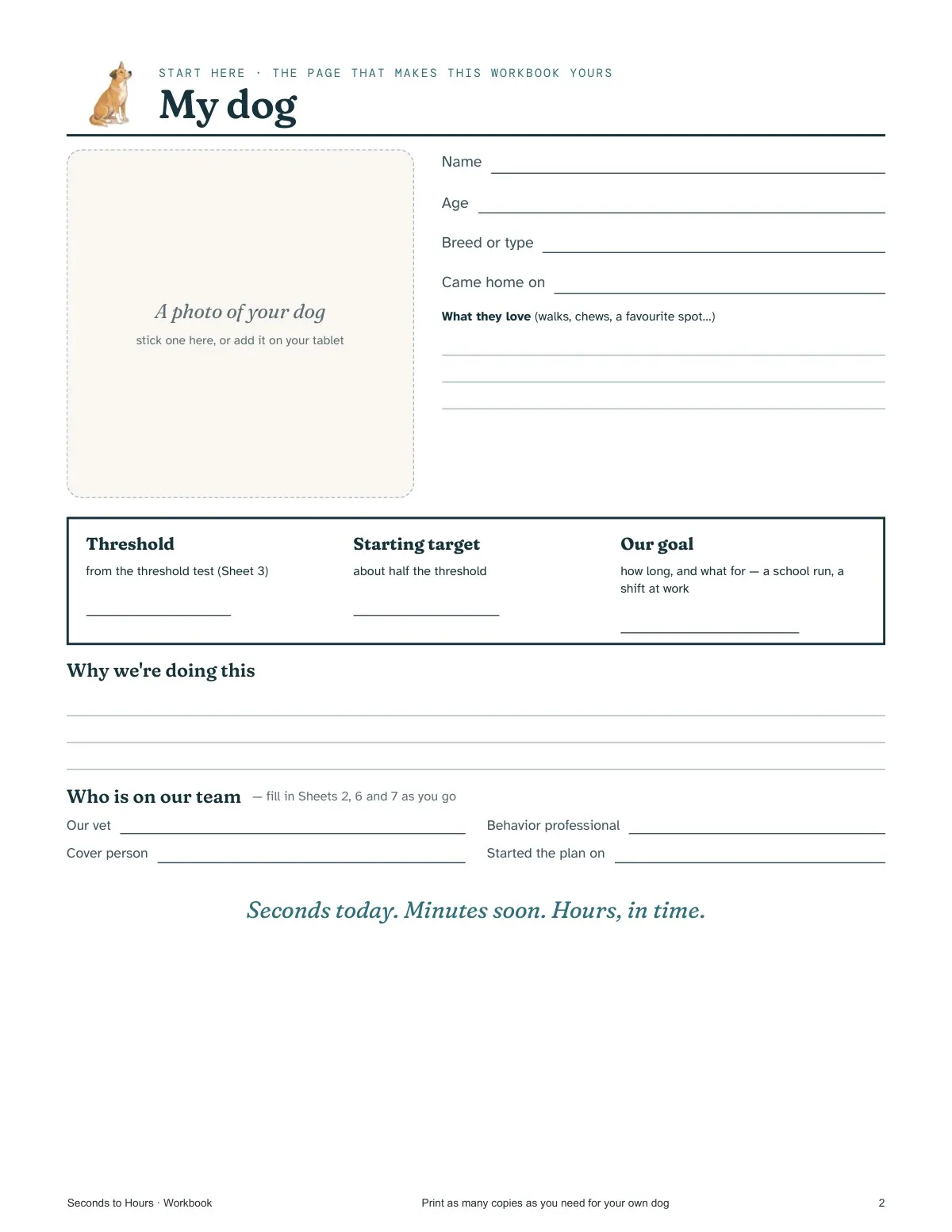
19 fillable pages — type on a tablet or print. Threshold test, session log, absence-cover plan, vet visit sheet, weekly review, progress chart and milestones, plus 4 sheets filled in for a fictional dog so you can see how it's done.
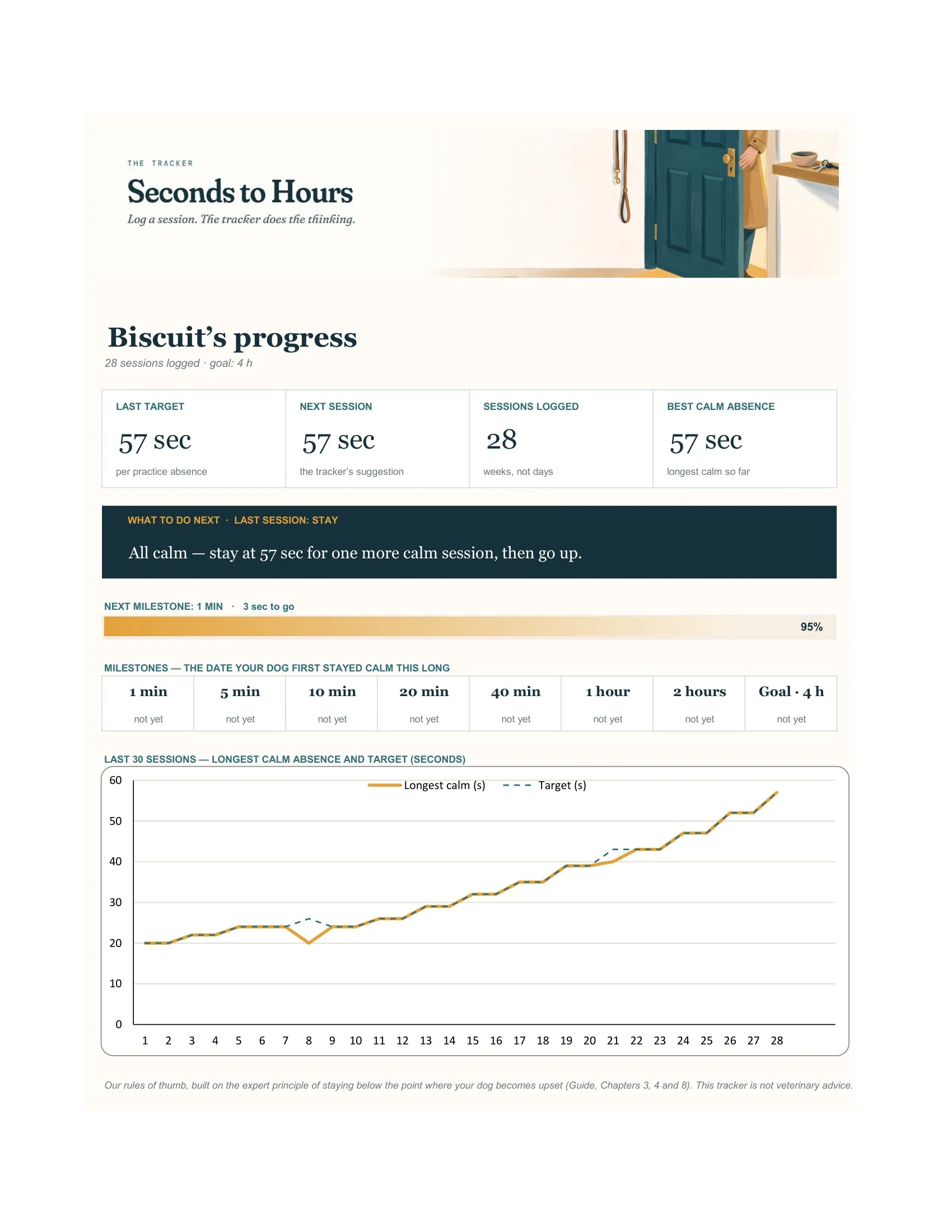
An Excel spreadsheet that turns each session into a clear next step, tracks milestones and flags when to stop.
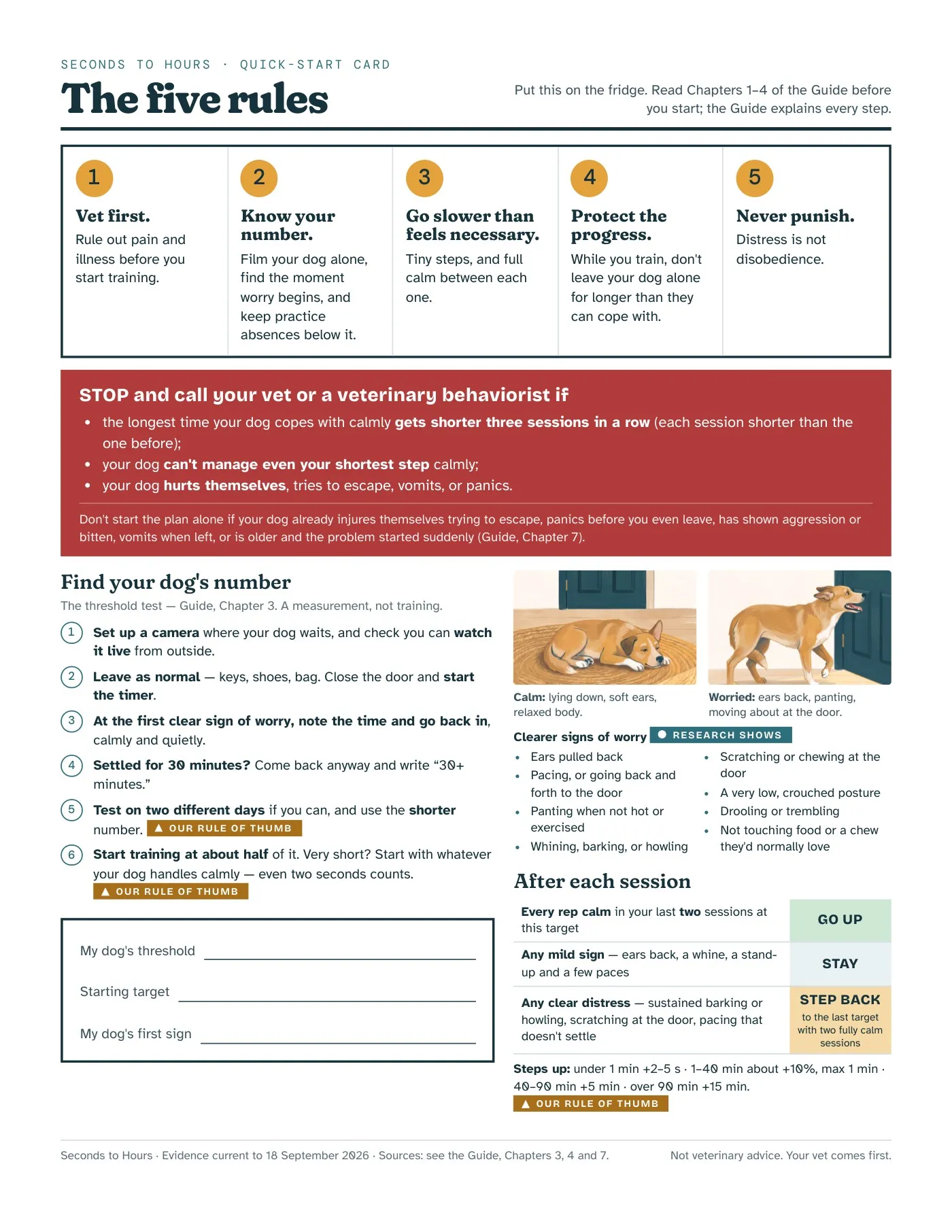
The five rules, the stop rule and the test on one page for the fridge.
No. Separation problems can be caused or made worse by pain and illness, and some dogs need medication only a vet can prescribe. The plan starts with a vet visit and tells you exactly what to ask. It also lists the red flags that mean you should get professional help before training at home.
Think in weeks and months, not days. In a controlled trial, a structured behavior program helped most dogs within 12 weeks (Blackwell et al., 2006) — some move faster, many move slower. The Tracker shows the progress you can’t feel day to day.
If your dog worries before you even leave, or can’t cope with a few seconds, the Guide has a separate first stage for the leaving routine — and it will recommend involving a professional. If your dog injures themselves trying to escape, please see a vet or veterinary behaviorist first.
The Tracker is an Excel spreadsheet (.xlsx). The Workbook is a fillable PDF you can type into on a tablet or computer, or print — and the back of it shows four sheets filled in, so you can see what goes where. If you don’t use Excel, the Workbook’s paper session log does the same job by hand.
That’s the idea at its simplest — the hard parts are knowing where to start, how big each step should be, what to do after a wobble, and how to cover the rest of your day while you train. That is what the kit is for.
Never. The plan is reward-based only. Controlled studies found no advantage for electronic collars and more signs of stress, and veterinary bodies advise against devices that cause pain or discomfort.
An 82-page illustrated Guide (PDF), a fillable Workbook (PDF) with 19 sheets plus 4 filled-in examples, the Excel Tracker and a one-page Quick-Start Card. Instant download. Your PDFs are yours to keep.
SureFoot Pets researches and writes plain-English guides for worried dog owners. We are not veterinarians — so every clinical statement is attributed to a named study or veterinary body, and each section is labeled “Research shows”, “Experts advise” or “Our rule of thumb” so you can see how strong the ground is.
More questions? 45 common questions, answered with sources.
Browse the Learn library by topic →
Limping, a cruciate tear or an older dog slipping on the floor? Read our sourced mobility and knee-brace guides →
Not ready yet? Start with the free guide — the complete threshold-test chapter and the Quick-Start Card.
Free PDF · 14 pages · 25 cited sources. No card needed.
